Transfer Madness 2026: Tottenham Spend £235m, Chelsea Break Records, Real Madrid Hunt Rodri — Europe's Summer of Football Excess
LONDON / MADRID — July 25, 2026
The summer of 2026 was always going to be extraordinary for the European transfer market. Every World Cup year generates a surge in transfer activity — players who have performed brilliantly on the global stage attract attention they could not have commanded six months earlier, and clubs who have spent the tournament watching matches from their sofas return to their offices in July with targets identified, budgets approved, and agents' phones ringing. But even by those elevated standards, the 2026 summer window has been something else entirely. As of July 25, 2026, the combined transfer activity of the Premier League and La Liga has produced a spending total that is rewriting the record books and generating debate about the long-term financial sustainability of elite European football.
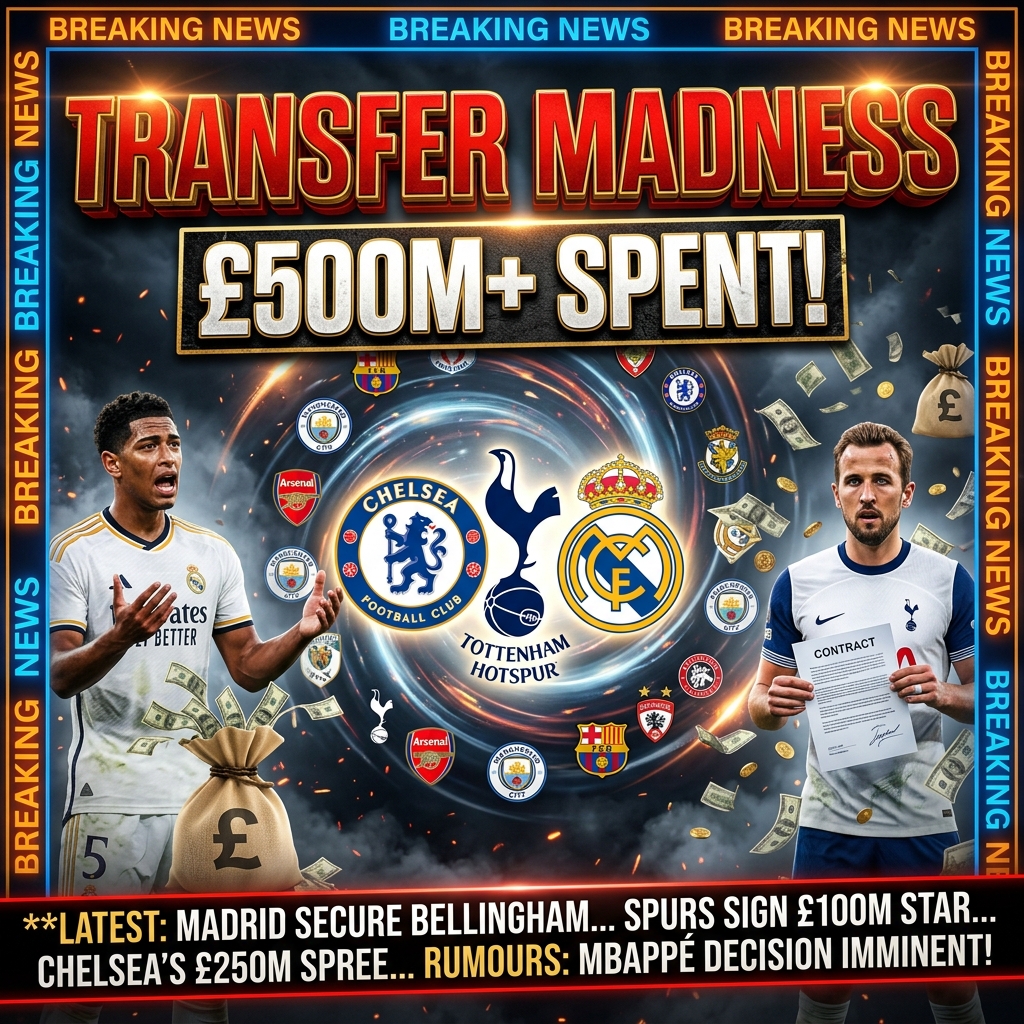
The headline: Tottenham Hotspur, Chelsea, and Real Madrid are conducting three of the most aggressive transfer campaigns in the history of their respective clubs. Simultaneously. In the same summer window. At price tags that would have been considered fantastical five years ago.
Tottenham Hotspur: The Roberto De Zerbi Revolution
When Tottenham appointed Roberto De Zerbi as head coach in the summer of 2025, it was an appointment that signalled a genuine philosophical ambition. De Zerbi — the Italian who transformed Brighton into the most beautiful football club in England and then took the project to Marseille before Spurs came calling — does not do conservative football. He does not do pragmatic 4-4-2 or deep defending. He does possession-based, positionally aggressive, technically demanding football that requires players of very specific profiles: technically excellent, positionally intelligent, physically capable of sustaining high defensive output.
Tottenham's board, apparently persuaded by De Zerbi's vision, gave him what few managers in their position have received: genuine financial backing. The spending figures, as of July 25, exceed £235 million on new arrivals.
The marquee signing is Sandro Tonali from Newcastle United — a £100 million deal that reunites the Italian midfielder with his compatriot manager. Tonali, whose career was interrupted by a betting scandal in 2023 but who has rebuilt himself with remarkable discipline and determination, is now considered one of the two or three best central midfielders in Europe. His engine — the relentless pressing, the ball-winning, the ability to drive box-to-box for 90 minutes — is exactly what De Zerbi's system demands. At £100 million, he is expensive. At his level, he is a statement of intent.
Mateus Fernandes — the Portuguese midfielder from Sporting CP — represents the technical, creative counterpart to Tonali's physical dominance. Jan Paul van Hecke from Brighton (De Zerbi's former club) adds defensive solidity. Andrew Robertson provides experienced left-back cover. Martin Dúbravka offers goalkeeping competition. Each signing is clearly identifiable as a De Zerbi player — technically proficient, tactically versatile, suitable for a high-press system.
De Zerbi has publicly stated that his next priority is the attacking positions — suggesting that Tottenham's spending this summer is not yet close to complete.
Chelsea Under Xabi Alonso: Rebuilding on New Foundations
The appointment of Xabi Alonso as Chelsea manager in the summer of 2025 was one of the most anticipated managerial moves in English football for years. The Spaniard, who transformed Bayer Leverkusen into Bundesliga champions and built a style of play that had managers across Europe studying his work, was expected to bring clarity and identity to a club that had spent three years under various managers pursuing the same objective without success.
Alonso's first full summer transfer window has been defined by one extraordinary number: £117 million for Morgan Rogers from Aston Villa. Rogers — the England international who played a significant role in Aston Villa's Champions League campaign and who has developed from promising talent into elite player over the past two seasons — becomes Chelsea's most expensive signing in history. The investment is a signal that Alonso is building his system around Rogers as the creative engine — the player through whom the team's attacking patterns flow.
Supporting Rogers' arrival, Chelsea have signed Geovany Quenda — the Portuguese winger from Sporting CP who represents one of the most exciting young talents in European football — for £43 million. Additional signings in defence (Marco Palestra from Atalanta) and attack (Emmanuel Emegha) complete a squad renovation that is not cheap but feels coherent. For the first time in several years, Chelsea look like a club with a defined footballing idea rather than a collection of expensive individuals searching for an identity.
Real Madrid: The Mourinho Era Begins
The appointment of José Mourinho as Real Madrid manager — his second stint at the club after his 2010–2013 period — was perhaps the most surprising managerial story of the 2025 close season. Mourinho, now 63, spent several years in television analysis and management roles before Real Madrid's board — dissatisfied with results under Carlo Ancelotti's successor — made the call that felt either like genius or madness, depending entirely on your view of what modern top-level management requires.
His transfer activity in the 2026 summer window reflects a man who knows precisely what he wants. Bernardo Silva arrives on a free transfer from Manchester City — a signing that, at zero pounds in fee, is nevertheless one of the most significant business deals in La Liga this summer. The Portuguese midfielder, now 32, brings intelligence, versatility, and unmatched consistency to a Madrid midfield that has lacked a player of his profile since Luka Modrić entered his final years.
Ibrahima Konaté joins from Liverpool, providing defensive reliability alongside Antonio Rüdiger. Marc Cucurella — the left back who established himself as one of England's best in his position during his Chelsea years — arrives for £52 million. Denzel Dumfries from Inter Milan adds dynamism at right back. The defensive reinforcement is clear: Mourinho, always a manager who builds from the back, is constructing the foundation first.
The rumour that dominates all other transfer gossip from Madrid, however, is Rodri. The Manchester City and Spain midfielder — World Cup winner with Spain in July, arguably the best defensive midfielder in European football — has only 11 months remaining on his contract and is currently recovering from back surgery. Real Madrid's reported contact with Manchester City to explore a deal has generated enormous media coverage and enormous tension between the two clubs. Whether City will sell, whether Rodri will choose to move, and whether the price tag (rumoured at €150 million) reflects the realities of his injury situation remain the outstanding questions of a summer window that shows absolutely no signs of slowing down.
The Financial Question No One Wants to Answer
The collective spending of these three clubs alone — exceeding €500 million when European accounting is applied — prompts a question that UEFA's Financial Sustainability Regulations have attempted to address but have not yet resolved: how sustainable is this? The post-World Cup summer has historically been the most expensive window in football, and 2026 appears to be following that pattern with exceptional vigour.
For supporters, the extraordinary transfer activity is exciting. New players, new possibilities, renewed ambition. For economists and football administrators, the same activity is a source of quiet anxiety — a reminder that the gap between clubs with access to elite financial resources and those without continues to widen, and that no regulatory framework yet devised has meaningfully closed it.
The 2026-27 European football season has not yet kicked off. When it does, it will do so with squads transformed by a summer that redefined what the transfer window means. For good or ill, the game that begins in August will look measurably different from the one that ended in May.
2026 Summer Transfer Window — Key Deals (As of July 25, 2026)
- Tottenham: Sandro Tonali (€108m), Mateus Fernandes (€99m), Jan Paul van Hecke (€61m)
- Chelsea: Morgan Rogers (€138m), Geovany Quenda (€43m), Marco Palestra (€30m)
- Real Madrid: Bernardo Silva (free), Ibrahima Konaté (free), Marc Cucurella (€52m), Denzel Dumfries
- Barcelona: Karim Adeyemi (Dortmund), Anthony Gordon (€80m, Newcastle), Lee Kang-in (PSG)
- Hot Rumour: Rodri (Man City) → Real Madrid — €150m potential deal
- Window Closes: September 1, 2026 (23:00 BST)
— SportsX Editorial Desk | Transfer Window 2026 Special Report